
Webinar Details:
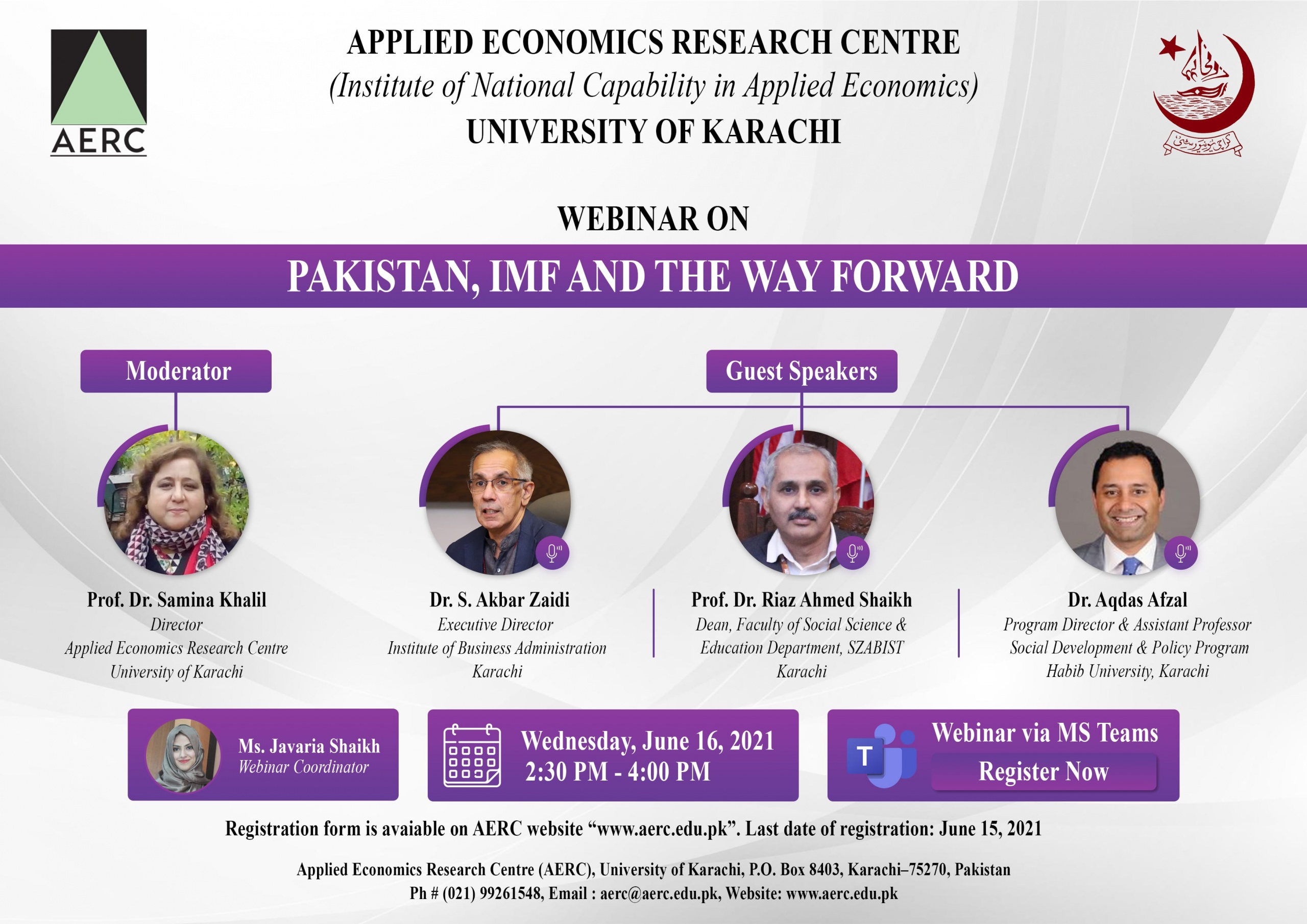
Moderator:
Prof. Dr. Samina Khalil
Director
Applied Economics Research Centre
University of Karachi
Guest Speakers:
Dr. S. Akbar Zaidi
Executive Director
Institute of Business Administration
Karachi
Prof. Dr. Riaz Ahmed Shaikh
Dean, Faculty of Social Science &
Education Department, SZABIST
Karachi
Dr. Aqdas Afzal
Program Director & Assistant Professor
Social Development & Policy Program
Habib University, Karachi
AERC Webinar on Pakistan, IMF and the Way Forward - A Brief
Prof. Dr. Samina Khalil, Director, Applied Economics Research Center, University of Karachi took the initiative of organizing and conducting the webinar from the platform of the AERC on the topic “Pakistan, IMF and the Way Forward” on Wednesday June 16, 2021. Dr. Khalil invited a diverse panel of discussants including Dr. Akbar Zaidi, Executive Director, IBA Karachi, Prof. Dr. Riaz Shaikh, Dean, Faculty of Social Sciences, SZABIST, Karachi and Dr. Aqdas Afzal, Program Director and Assistant Professor, Habib University, Karachi.
Prof. Dr. Samina Khalil in her opening remarks said that Pakistan since the beginning has dependent upon the aids and grants from the international donor agencies. Pakistan is among top 10 countries of the world that have used IMF plan to escape economic chaos and bankruptcy. Dr. Khalil added that the research shows that Pakistan benefits from these programs remain limited while it has caused the adverse effect at large. She further said that the finance minister of Pakistan on various platforms expressed his concerns over the conditionality of the 23rd (current) IMF program. The current program emphasizes over achieving the fiscal sustainability, and making the power sector financially viable. Strategically speaking Dr. Khalil added the program aims to align the structural problem of the country. She added the IMF Press release of March 2021 quoting “Fiscal performance in the first half of FY 2021 was prudent, providing targeted support and maintaining stability. Going forward, further sustained efforts, including broadening the revenue base carefully managing spending and securing provincial contributions, will help achieve a lasting improvement in public finances and place debt on a downward path. Reaching the FY 2022 fiscal targets rests on the reform of both general sales and personal income taxation. Protecting social spending and boosting social safety nets remain vital to mitigate social costs and garner broad support for reform. “Despite recent improvements, further efforts to remove structural impediments will strengthen economic productivity, confidence, and private sector investment. These include measures to (i) bolster the governance, transparency, and efficiency of the vast SOE sector; (ii) boost the business environment and job creation; and (iii) foster governance and strengthen the effectiveness of anti-corruption institutions. Also, completing the much-advanced action plan on AML/CFT is essential.” Prof. Dr. Samina concluding her remarks said that the Pakistan’s progress in view of this release sounds promising but there apprehension remains as to see how the country can adopt and implement the policy options.
Dr. Akbar Zaidi, Executive Director, IBA Karachi, in his remarks said that Pakistan has taken 23 IMF programs so far but was only able to complete 3 of the programs reform agenda. Analyzing the impact of IMF plans on the regional competitors Dr. Zaidi added that China has taken only 2 programs from IMF and that last program was also decades ago in the year 1986. While India a state with similar issues with relevance to Pakistan took its last IMF program about 30 years ago in 1991, with per capita relatively low and huge population size as compared to Pakistan. Bangladesh, a relatively newly emerging state took last IMF program in 2012, he added. Analyzing the growth rates of China, India and Bangladesh, Dr. Zaidi explained that all these countries witnessed accelerated growth rates after 40, 30 and 9 years of leaving IMF programs behind respectively. He further added that as a matter of fact all of these countries developed on socio-economic grounds without the assistance of IMF far ahead of Pakistan. Dr. Zaidi further emphasized that Pakistan average growth rate despite of IMF programs declined from more than 5 percent to over 3.5 percent over a long period of time. He further added that Pakistan’s economy has become an addicted economy of IMF programs, aids and loans since 1950. He said that Pakistan every other year takes more loans to pay off the previous loans and this vicious cycle is continued since the beginning. Dr. Zaidi further elaborated that during East Asian crisis South Korea took about USD 70 billion dollars as loan from IMF followed by Taiwan and Philippines while Malaysia rejected the idea of taking the loan from IMF for stabilizing the economy. The Asian Tigers returned the loan within or before the time period to IMF while Malaysia without the dependence of IMF was able to stabilize the economy within two years of crisis, which gives a lesson of self-reliance like China, India and Bangladesh. Dr. Zaidi talking about his third hypothesis said that whichever country gets trapped in IMF programs and its conditionality fails to prosper and grow. Pakistan got the loan of USD 3.6 billion dollars which could have been generated domestically instead of opting for the IMF plans. He also added that Pakistan by using the resources at the maximum capacity can generate the amount equivalent to the loans taken from IMF. He further added the elite ruling class of the Pakistan does not tax the elite of the society and fails to expand the resources and depends on IMF for bailing the country out. He further added that Pakistan should not go to IMF and should instead introduce reforms in tax collection as the country currently collecting only 20 percent of the total tax capacity.
Prof. Dr. Riaz Shaikh, Dean, Faculty of Social Sciences, SZABIST, Karachi, while establishing his views said that Pakistan is well aware of the conditionality that follows by the loans given by IMF but still chooses to opt for it every other time. He further pointed out the objective behind creating IMF is hegemony and dominance of the world order. He also highlighted that the IMF programs are not aid, it is the loan that any country takes in order to fight its financial and economic crisis and IMF gives it to attain its objectives. He also added the long run transformation of the economy talks about the reform agenda, structural changes and stabilization of exchange rate. He said Pakistan on the other hands emphasis over the ad-hoc releases which aim to solve short term liquidity issues, exchange rate and crisis in the economy instead of long run transformation. Pakistan lacks trading activities within the region which limits Pakistan’s potential to gain from trade and thus end up taking IMF plans to fight crisis. He further added that Pakistan over a span of years is still exporting the same conventional items and has failed to bring about innovation that could help the country to explore new markets and increase the market share. Discussing the present scenario of the country, Dr. Shaikh said that Pakistan attracted hot money by increasing the interest rate to 13 percent which lead to further worsening of the economic cycle of the country. He further added that the new conditions of IMF include privatization and imposing taxes on social security benefits with the significant impact on the pensions. While in concluding remarks Prof. Shaikh said that Pakistan is self-sufficient in generating resources that would help the country to sustain without the help of IMF programs.
Dr. Aqdas Afzal, Program Director and Assistant Professor, Habib University, Karachi addressed three major questions related to IMF and the future of Pakistan. Dr. Aqdas’s discussion ranges over to why Pakistan opts for IMF plan, what IMF asks Pakistan against the loan it provides and lastly the way forward. Dr. Afzal in his discourse said that Pakistan in the current IMF plan over the period of 03 plus years is taking USD 06 billion loan. He said that in every program the country opts for IMF proposed privatization, liberalization and de-politicization of the policymaking institutions. Dr. Afzal said that primarily Pakistan opts for IMF programs because of negative balance of payment which is due to limited earnings from exports that fails to offset the import bill of the country. He further added that the terms of trade of Pakistan is relatively weak as compared to other nations, as the country today only emphasizing over conventional items. He further suggested that the terms of trade of a country could be better off when Pakistan would start investing in better quality education and innovation. He added that the median years of schooling in Pakistan is primary level education while in the neighboring countries like India it is relatively high which gives an insight on why Pakistan lacks the vision of innovation and value added products. He further added that currently the debate is between market and state that promulgates that minimum intervention of the state in market mechanism in enlarging the size of the pie of the economy. While the other school of thought believes that the equity gap is going to widen if the markets are set free without regulation. He further added that IMF emphasizes over de-politicization of the central institutions of the country so that the decisions are not biased are in the best interest of the country while the recent amendment of SBP autonomy is part of the outline. Dr. Aqdas in his concluding remarks said that Pakistan’s way forward to get out of the IMF circle would be to emphasize over value added products, competitive exports, reforms in education and poverty eradication.
Prof. Dr. Samina Khalil, Director AERC opened the floor for questions and thanked the speakers for their valuable insights and heated debate on the topic. The webinar ended with Dr. Khalil concluding remarks followed by the vote of thanks to the eminent guests.